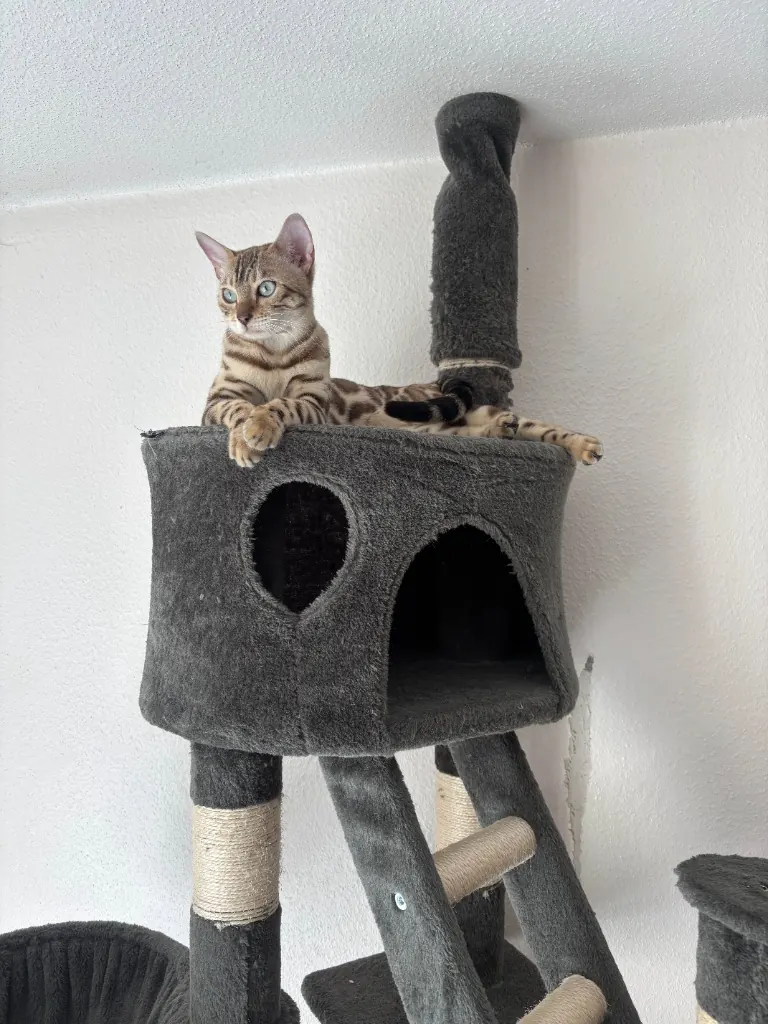
Tested parents do not guarantee a life free of illness, but they rule out known risks. Here are the tests that matter in the Bengal, and the questions to ask the breeder.
Why test breeding cats
Some hereditary diseases are passed from parents to kittens without the parents themselves being ill. Testing breeding cats before pairing them avoids producing affected kittens. It is one of the first things that set a careful cattery apart from mere kitten production.
There are two broad families of tests. DNA tests, done once and for all from a swab, show whether the cat carries a known mutation. Screenings, such as ultrasound, describe the state of an organ on a given date and must be repeated.
No test covers everything. But a breeder who tests, shows the results and takes them into account when pairing cats gives you valuable information you could not get any other way. These results are also the sign of a cattery that thinks long term, beyond the current litter.
PKDef and PRA-b: two essential DNA tests
Pyruvate kinase deficiency, or PKDef, is a hereditary disease of the red blood cells that can cause anaemia of varying severity. It is passed on recessively: a cat must inherit the mutation from both parents to be affected. A DNA test shows whether a breeding cat is clear, a carrier or affected.
PRA-b is a form of progressive retinal atrophy described in the Bengal. It causes a gradual loss of sight that begins at a young age. It too is recessive, and a specific DNA test can identify it in breeding cats.
A carrier cat is not ill. Paired with a clear partner, it will produce no affected kittens, although some kittens may be carriers in turn. What must be avoided is pairing two carriers: that is exactly what the tests help prevent.
HCM: ultrasound rather than DNA
Hypertrophic cardiomyopathy, or HCM, is a disease of the heart muscle that affects many cat breeds, including the Bengal. DNA tests exist for some breeds, such as the Maine Coon or the Ragdoll, but they target mutations specific to those breeds. There is currently no reliable DNA test for HCM in the Bengal.
Screening is therefore done by heart ultrasound, carried out by a vet trained in this examination. It measures the thickness of the heart walls and detects any abnormalities. The examination is painless and is usually done without anaesthesia, with the cat simply held gently for a few minutes.
Because HCM can appear in adulthood, a normal result is only valid for the date of the examination. Careful breeders repeat their breeding cats’ ultrasounds at regular intervals. Ask for the date of the last examination, not just its result.
PKD, FIV and FeLV
Polycystic kidney disease, or PKD, causes cysts to form in the kidneys. It is best known in the Persian and related breeds, for which a DNA test has been developed. In the Bengal, some breeders include it in their monitoring, by DNA test or kidney ultrasound, as a precaution.
FIV and FeLV are two serious viral diseases that spread between cats, often called feline AIDS and feline leukaemia. A blood test checks the breeding cats’ status. In a cattery, this is an essential basis for protecting adult cats and kittens alike.
Our females are screened for FIV and FeLV and tested for PKDef and PRA-b, with negative results. Our health page explains our approach, and we are happy to share the documents with families who contact us. Being open about our cats’ health is part of the way we breed, just like socialising the kittens.
What a buyer should ask
Do not hesitate to ask precise questions: a reputable breeder expects them and will answer plainly. A result stated verbally is not worth a document. Ask to see the certificates, with the cat’s name, its identification number, the laboratory or vet and the date.
Be wary of vague phrases like “tested parents” with no further detail, or “tests up to date” without documents. And keep in mind that the kitten itself does not always need to be tested: if both its parents are clear of a recessive disease, so is it.
- The PKDef and PRA-b results of both parents
- The date of the last heart ultrasound
- The FIV and FeLV status of the breeding cats
- The PKD monitoring chosen by the cattery
- Documents in the cat’s name, not just a mention
Frequently asked questions
Is a kitten from tested parents guaranteed to be healthy?
No, no test guarantees perfect health. Tests rule out known hereditary diseases, which is already a lot. The rest also depends on how the kittens are raised, veterinary care and the care the cat receives throughout its life.
Why is there no DNA test for HCM in the Bengal?
The available tests detect mutations identified in other breeds, notably the Maine Coon and the Ragdoll. No reliable mutation has been validated for the Bengal to date. That is why screening relies on heart ultrasound, repeated over time.
Can a carrier cat be used for breeding?
For a recessive disease, a carrier paired with a clear partner will produce no affected kittens. Some breeders make this choice to preserve genetic diversity, provided they know each breeding cat’s status. Pairing two carriers, however, must be avoided.
Read next