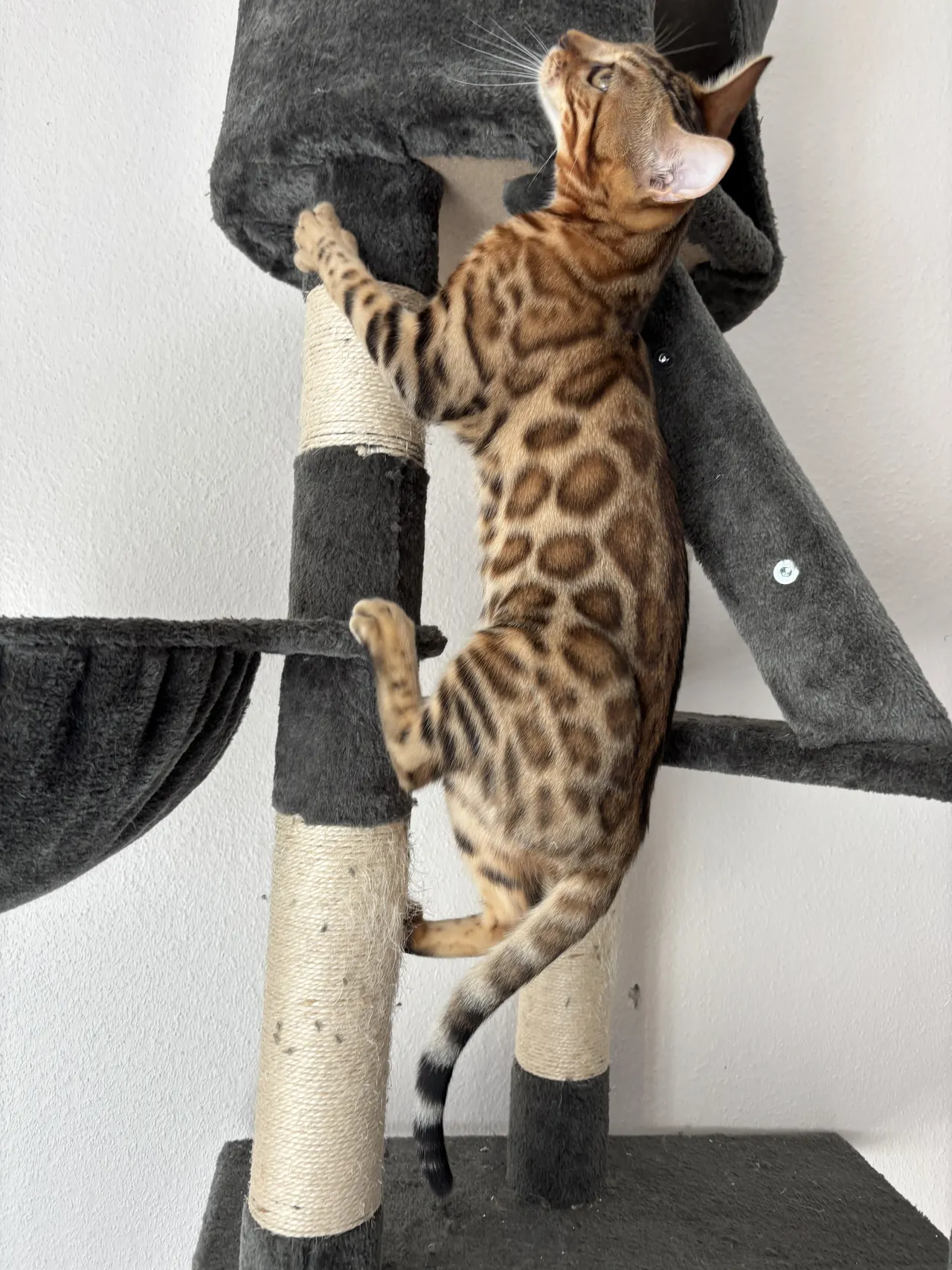
A Bengal can thrive in a flat. Floor space matters less than what it finds there every day: height, play, things to discover and company.
Yes, it is possible, on one condition
People often say a Bengal needs a house with a garden. In reality, many Bengals live very happily in flats. What makes the difference is not the number of square metres, but how they are arranged and the time you give your cat each day.
The Bengal is an active, curious and playful cat. If it gets bored, it will find its own ways to keep busy, and they will not always be to your taste: opened cupboards, knocked-over objects, insistent meowing. A flat designed with it in mind, on the other hand, lets it burn off its energy calmly.
Before adopting, ask yourself one simple question: will you be able to play with it every day, even on tired evenings? If the answer is yes, a flat is no obstacle. The rest is a matter of setting things up, and that is the most enjoyable part.
Think vertically
A cat does not live only on the floor. For a Bengal, height is a territory in its own right: it loves to climb, watch from a high point and jump from one level to another. Every reachable shelf adds usable space to your flat without taking up an inch of floor.
The first investment is a sturdy, tall and very stable cat tree. An adult Bengal is muscular and jumps with momentum: a light model that wobbles will soon put it off. Ideally place it near a window, so it can keep an eye on the outside world, one of its favourite pastimes.
You can add wall shelves, walkways or a hammock fixed up high. The idea is to create a circuit with several possible routes. If there is tension with another animal, these high spaces also let everyone keep their distance.
- A tall, heavy cat tree
- Wall shelves arranged like steps
- A lookout post near a window
- A vertical scratching post, tall enough to stretch
Daily play, a fixed appointment
Play is at the heart of a Bengal’s life in a flat. Two or three short sessions a day, of ten to fifteen minutes, are better than one long session at the weekend. A feather wand or a toy on a string is still the most effective, because it imitates prey and you bring it to life yourself.
Let your cat catch its prey at the end of the session. The full cycle, stalking, chasing, pouncing, catching, calms it far more than an endless chase. Laser pointers often frustrate cats for this reason: there is never anything to catch.
Many Bengals also love to fetch small objects or learn tricks with treats. These moments strengthen your bond and occupy its mind as much as its body. Put string toys away after use: a cat left alone with a string can swallow it.
Enriching its environment
A Bengal needs novelty. Rotate its toys rather than leaving them all out: a toy put away for a week becomes interesting again. A cardboard box, a paper bag without handles or a tunnel is often enough to spark its curiosity, at no cost.
Treat-dispensing toys and snuffle mats turn mealtime into an activity. Your cat has to search, handle and think, which suits its temperament well. Start with simple models so it succeeds quickly, then increase the difficulty.
Think about the senses too: a water fountain, which many Bengals enjoy, cat grass to nibble, new smells to explore. A rich environment is not a cluttered one; it is one that changes a little and always offers something to do.
Harness and windows: going out and getting fresh air safely
A Bengal can learn to walk on a harness, especially if training starts early and gently. First let it wear the harness at home for a few minutes, with a reward. The first outings take place somewhere quiet. Some cats come to enjoy it, others do not: respect its pace.
Windows and balconies are the real danger in a flat. Falls are common in cats, even agile ones, that launch themselves after a bird or an insect. A safety net on the balcony and sturdy, well-fixed screens let you air the flat without risk.
Be especially careful with tilt-and-turn windows: a cat that tries to get through the tilted opening can get stuck and be seriously injured. Special guards exist for this type of window. Making your flat safe before the kitten arrives saves a lot of scares.
Frequently asked questions
How much space does a Bengal need in a flat?
There is no minimum size. A modest flat well equipped with high spaces, with play every day and things to do, is better than a large empty home where the cat is left alone. What matters most is how it is set up and the time you give it.
Can an indoor Bengal stay alone during the day?
It can stay alone during your working hours, as long as it has things to do and then enjoys real play time with you. If it is often alone for long periods, a second cat with a compatible temperament is worth considering.
Does a Bengal in a flat need a second cat?
It is not essential, but it is often a good idea if the household is away for much of the day. A playful second cat shares its energy. Introductions must be gradual, though, and each cat should have its own resources.
Read next