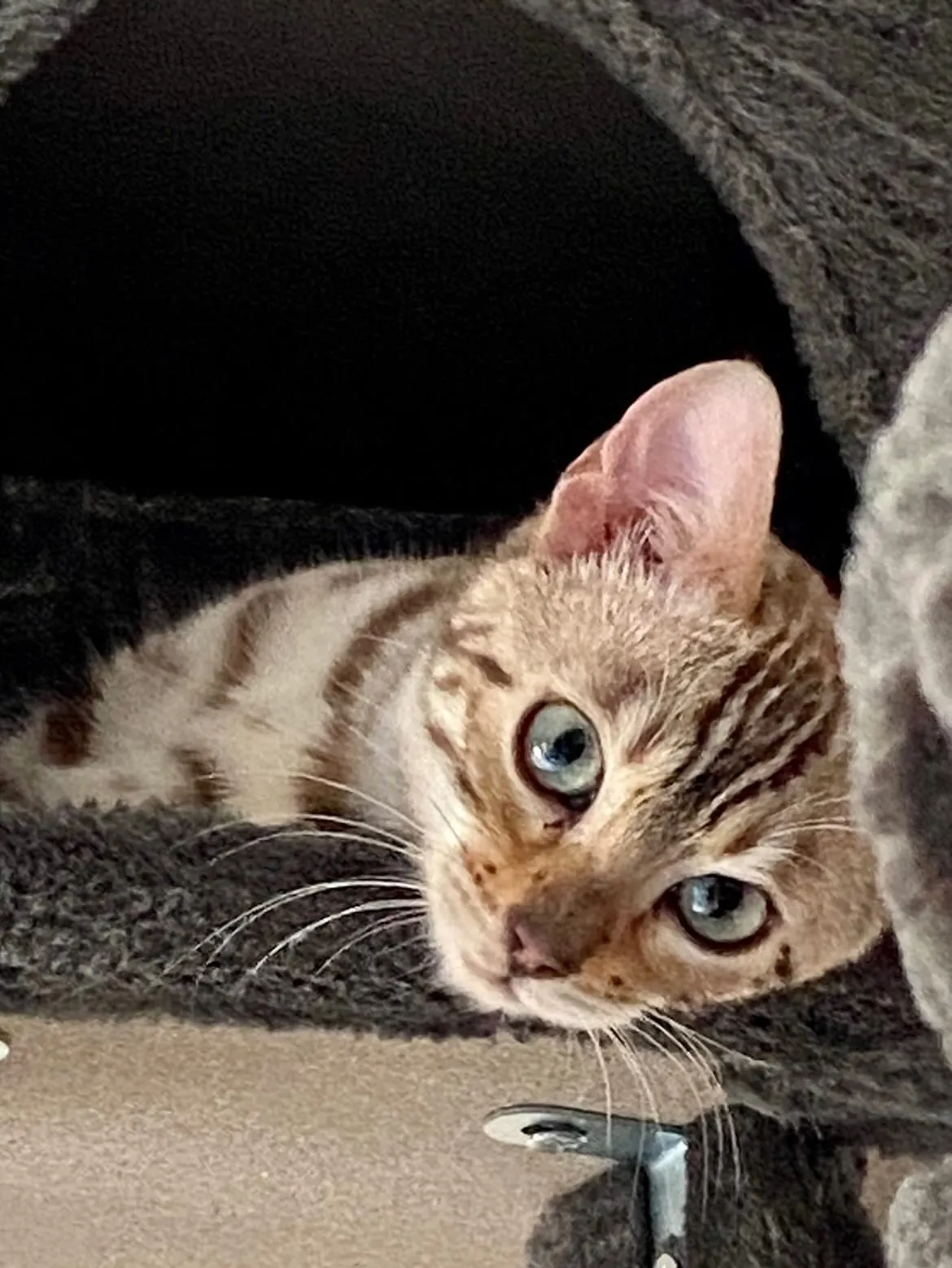
A Bengal’s coat is read in two steps: a pattern, then a colour. Here is how to find your way, from the original brown to the snow shades, and what the eyes tell you about each coat.
Pattern before colour
Before talking about colour, look at the pattern. The Bengal comes in two main patterns. Spotted, the best known, is covered in spots. When these spots are outlined in a darker shade around a lighter centre, they are called rosettes, like on a leopard’s coat. This is the pattern that made the breed famous.
Marbled shows horizontal swirls that wrap around the flanks, a little like scrollwork. It is rarer, and each cat has a truly unique pattern. Both patterns are recognised, and neither is better than the other: it is a matter of taste.
In every case, the standard looks for a sharp contrast between the pattern and the background, and a marked belly too. Some Bengals also have a golden or pearly sheen on the coat, called glitter, which catches the light.
Brown, the original coat
Brown is the Bengal’s historic colour, the one most reminiscent of its ancestor, the Asian leopard cat. The background ranges from warm beige to gold, even reddish, with spots or marbling from brown to black. A beautiful brown is recognised by the sharpness of its pattern.
A brown Bengal’s eyes are usually green, gold or hazel. Bambi, our brown Bengal, is a good example of this warm coat, which remains the most common and the most easily recognised. Depending on the bloodline, the background may be warmer or cooler and the pattern darker or lighter: there are as many shades of brown as there are cats.
Do not judge too much by the look of a very young kitten. At a few weeks old, many Bengals go through a phase where the coat looks dull and fuzzy, the pattern as if blurred. This is normal: the contrast gradually returns as they grow, and the adult coat takes shape over several months.
Snow: three shades, three gazes
Snow Bengals have a light background, from creamy white to beige, with a more or less marked pattern. These coats come from colour genes inherited from the Siamese and the Burmese. There are three of them, recognised mainly by eye colour and the strength of the contrast.
Seal lynx point is the lightest: the kitten is born almost white and its pattern appears with age. Its eyes are always blue. Seal sepia is the darkest of the snows, with gold to green eyes. Seal mink sits between the two, and its eyes take on a blue-green shade known as aqua.
Azura, our snow mink female, is a good example: a light, warm background, a clearly readable pattern and those blue-green eyes so typical of the mink. Looking at a snow’s eyes is often the surest way to identify its shade.
- Seal lynx point: the lightest, blue eyes
- Seal mink: in between, blue-green (aqua) eyes
- Seal sepia: the darkest, gold to green eyes
Silver, all about contrast
Silver is recognised by its silvery, almost white background, against which the black or charcoal-grey pattern stands out very sharply. This coat is caused by a gene that removes the yellow pigment from the hair: the brown’s warm background becomes cool and bright.
A beautiful silver should show no yellowish tinges on the background, what breeders call tarnish. Its eyes are most often green or gold. The silver gene can also combine with a snow coat, giving for example a blue-eyed silver lynx point.
Silver is more recent in the breed’s history, and it appeals through its graphic elegance. As with the other colours, it is the quality of the contrast and pattern that counts, far more than the colour itself. A silver with a blurred pattern will never show off the breed as well as a perfectly contrasted brown.
What the coat does not tell you
The coat is the first thing you notice, and that is only natural. But it says nothing about the cat’s temperament or health. A snow is not calmer than a brown, a marbled is not more affectionate than a spotted: personality depends on the bloodlines, upbringing and socialisation.
Choosing a kitten on colour alone risks missing what matters most. We encourage you to look first at the parents, their health tests and the way the kittens are raised. The Bengal’s beauty is all the more valuable when it does not come at the expense of its health.
Frequently asked questions
What is a white, grey or black Bengal?
The “white Bengal” is the snow, with an ivory to cream background. The “grey Bengal” usually means the silver, with a silvery background. An all-black Bengal, called melanistic, does exist, but it is not recognised by show standards: its pattern only shows in bright light.
What is the rarest Bengal coat?
Rarity depends on the region and the bloodlines available, so it is hard to say. Brown spotted remains the most common. Marbled and some combinations, such as silver snows, are seen less often. Rare does not mean better: the quality of the pattern matters more.
How can you tell whether a snow kitten is lynx point, mink or sepia?
Eye colour is the most reliable clue: blue for lynx point, blue-green for mink, gold to green for sepia. The contrast of the coat also helps. If in doubt, a genetic colour test can confirm the shade with certainty.
Does a Bengal kitten’s coat change as it grows?
Yes, often. Many kittens go through a phase where the coat looks fuzzy and dull, then the contrast returns. Snows, especially lynx points, are born very pale and their pattern emerges with age. The adult coat can take several months to settle.
Read next