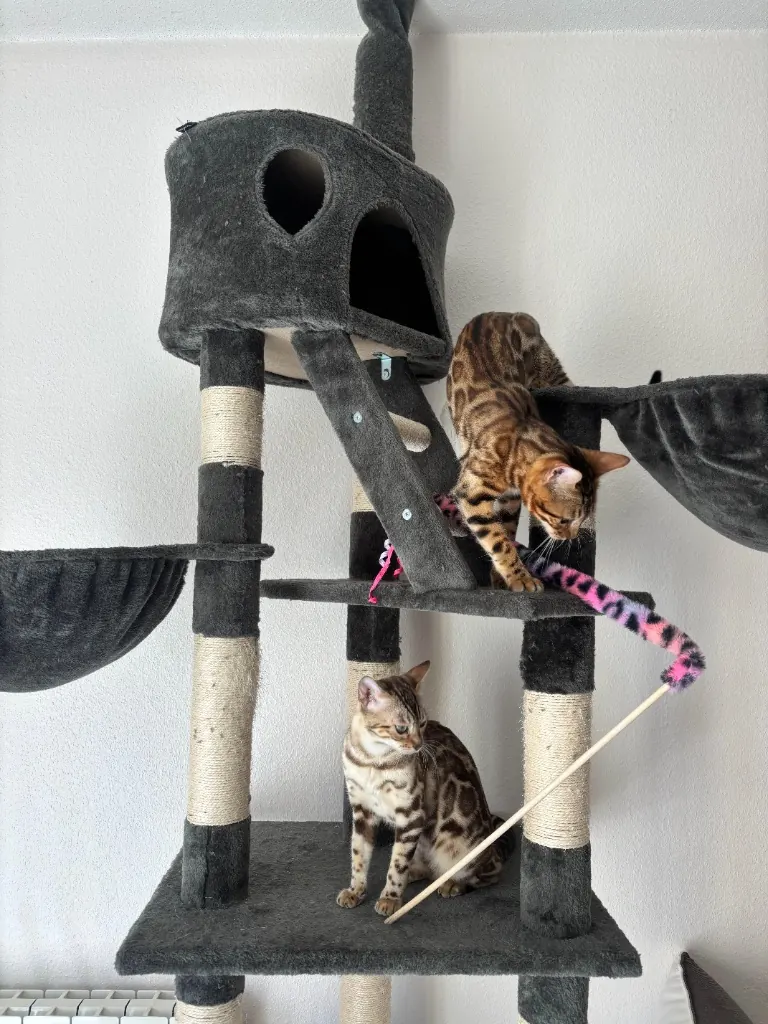
The Bengal wins people over with its coat, but it is its temperament that will shape your daily life. A lively, intelligent and very present cat, who gives a lot and asks just as much.
Energy that rarely switches off
The Bengal is an active cat. It runs, climbs, jumps and can play session after session without tiring. This energy is one of its great charms, provided you give it ways to spend it: play every day, height, opportunities to explore.
That does not mean it never rests. Like all cats, it sleeps for a good part of the day and enjoys quiet moments near you. But its waking phases are intense, and it expects the people around it to join in.
A Bengal that does not get enough activity will let you know, often through mischief or insistent calls. This is not a character flaw; it is a need that is not being met. Channelled well, this energy becomes a real bond.
Intelligent, and sometimes a little too clever
The Bengal learns quickly. It learns to open a door, to find the treat cupboard and to recognise the gestures that announce a play session. This intelligence makes it a fascinating companion, one you can teach tricks, recall or walking on a harness.
It also has a downside: a bored Bengal invents its own activities. Puzzle toys, snuffle mats and reward-based training are good ways to feed its mind. A cat that thinks is a calm cat.
Its curiosity knows no bounds. Nothing that happens at home escapes it, and it will often want to join in whatever you are doing, whether cooking, working or tidying a cupboard. Better to know it, and enjoy it.
Chatty, and often drawn to water
Many Bengals are expressive. They comment, call and answer when spoken to, with a sometimes surprising range of sounds. Not all are equally talkative, but a Bengal rarely stays completely silent when it wants something.
Water also holds an attraction for many Bengals that surprises families. Playing with the tap’s trickle, dipping a paw in the bowl, following their human to the shower: these behaviours are common. A water fountain often delights them and encourages them to drink.
This taste is not universal, and a cat should never be forced to get wet. Some Bengals are indifferent to water, which is just as normal. Simply remember to close the toilet lid, never to leave a full bath unattended and to cover buckets if your Bengal is one of the curious ones.
A cat that needs company
Contrary to the image of the independent cat, the Bengal is very attached to its home. It often follows its humans from room to room and likes to be part of household life. It is not always a lap cat, but it is a cat that wants to be around you.
Long days alone weigh on it. If your household is often away, the company of a second cat, or a sociable dog introduced gradually, can help it cope with those hours alone. Bengals generally get on well with other animals when they have been used to them from a young age.
This sociability is built from the very first weeks. That is why we raise our kittens at the heart of the home, in contact with the family and its noises: a well-socialised kitten approaches its new life with confidence rather than wariness.
Who is the Bengal right for?
The Bengal suits households that want a present cat and are ready to give it time every day. Families with respectful children, active couples, people working from home: many profiles can suit it, in a house or a flat.
It is less suited to someone looking for a discreet cat that is happy with little attention, or to a household that is out all day with no way of making up for it. Better to admit this before adopting: a misunderstood Bengal is an unhappy cat, and a disappointed family.
- Suitable if you enjoy playing and interacting every day
- Suitable if you can provide high spaces
- Less suitable if you dream of a very discreet cat
- Less suitable if the household is out all day
Frequently asked questions
Is the Bengal a wild cat?
No. The Bengal’s distant ancestor is the Asian leopard cat, but the Bengals offered by catteries are domestic cats, descended from many generations of domestic cats. It has kept a wild look and plenty of energy, not a wild temperament.
Is the Bengal affectionate?
It is very attached to its humans and loves their company, but it often shows affection by following, playing or snuggling up rather than staying on your lap for long. Every cat has its own personality, and the kitten’s socialisation plays a big part.
Is a Bengal suitable for a family with children?
Yes, often, provided the children learn to respect the cat and its quiet moments. The Bengal enjoys play and the bustle of a lively home. Play sessions with a feather wand are a lovely way to build a bond between children and cat.
Read next