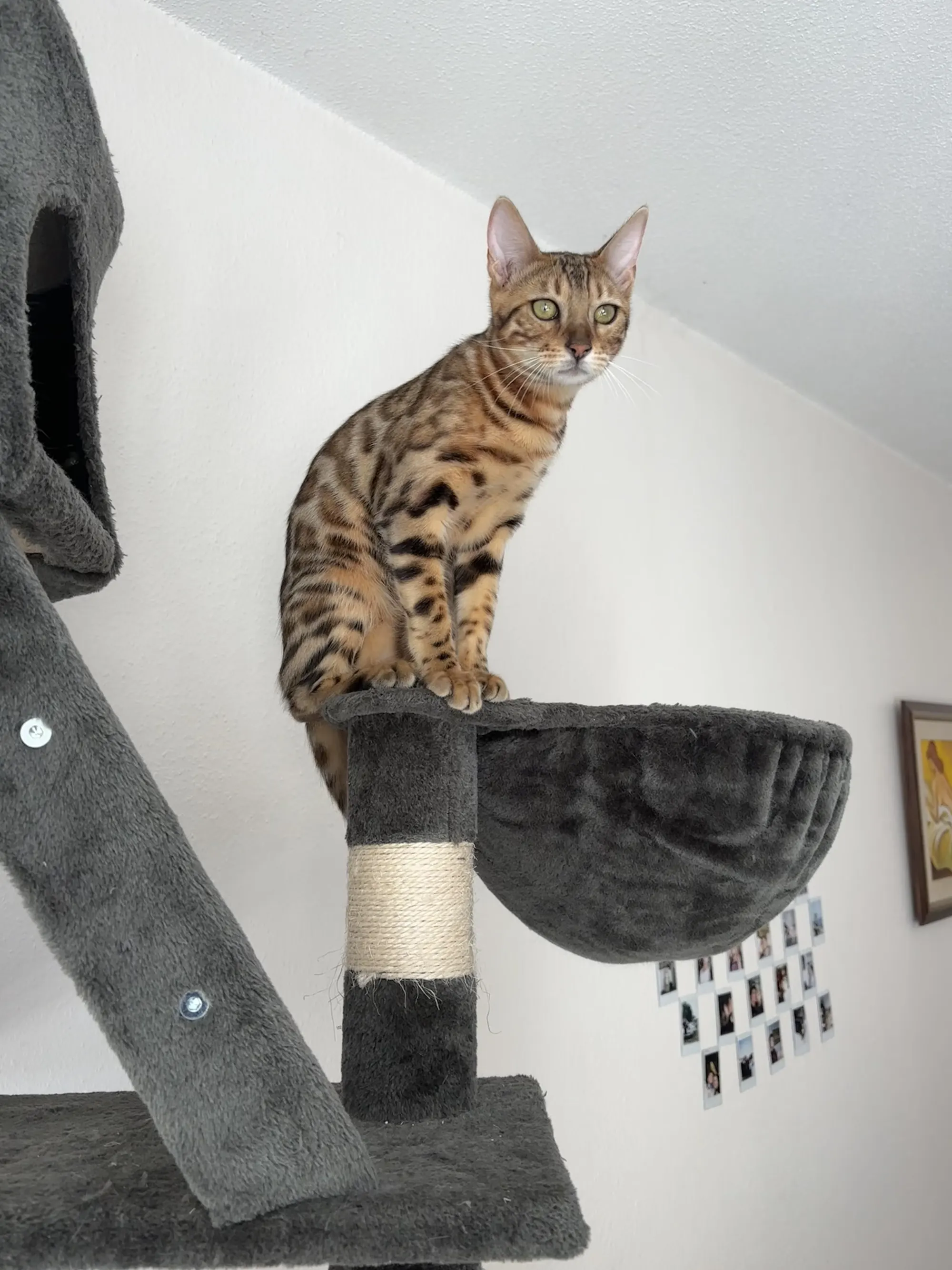
The price of a Bengal kitten is more than a figure in an ad. It reflects everything that was done before it came to you: chosen and tested parents, veterinary care, a pedigree and a great deal of time.
A kitten, and everything that comes before it
When you compare ads, you compare prices. Yet behind two kittens that look alike in a photo, there can be two very different stories. The price of a Bengal reflects less the animal itself than everything done before its birth and during its first weeks: choice of parents, health, papers, upbringing.
A careful cattery incurs costs long before a litter arrives. Breeding cats are bought from other breeders, fed, monitored and tested. The kittens then receive their first vaccinations, their microchip and several visits to the vet. None of this shows in a photo, yet all of it matters.
We would rather explain what a price covers than state it without context. Our terms are set out on our adoption page, along with what comes with the kitten when it leaves. That way you can compare like with like, and ask the right questions of every breeder you contact.
Pedigree, tests and veterinary care
In France, a cat can only be presented as a pedigree cat if it is registered in a stud book recognised by the Ministry of Agriculture: for cats, that is the LOOF. The pedigree certifies the kitten’s ancestry. A kitten without a pedigree can be adorable, but the ad cannot sell it as a Bengal.
The parents of a well-bred kitten are tested before breeding. In the Bengal, breeders test in particular for pyruvate kinase deficiency (PKDef) and the breed’s own form of progressive retinal atrophy (PRA-b), check FIV and FeLV status, and monitor the heart by ultrasound. Each test has a cost, and some are repeated over the years.
Then come the costs of the kittens themselves: vaccinations, a microchip registered with I-CAD, a veterinary certificate before the sale, deworming, not to mention the unexpected vet visit that always ends up happening. A cattery that skips these can show a lower price, but it is often the buyer who pays the difference later.
- LOOF registration and pedigree
- DNA tests of the parents (PKDef, PRA-b)
- FIV and FeLV screening
- Heart ultrasounds of the breeding cats
- Vaccinations, microchip and veterinary certificate
Time, the invisible cost
The Bengal is a lively and sensitive cat. A kitten that has grown up amid the noises of a home, people coming and going, and hands that handle it gently arrives with you far more relaxed. This socialisation work appears on no invoice, but it takes up a large part of our days while the kittens are at home.
With us, the kittens are born and grow up in our flat, at the heart of family life, not in a separate room. We get them used to brushing, to the carrier and to everyday sounds. We chose to breed little, about one litter a year, so we can give each kitten the time it deserves.
Time is also what we spend with families: answering questions, preparing for the departure, sending news, staying reachable afterwards. A price that includes this support cannot be compared with that of a kitten handed over in a hurry in a car park, with no advice or follow-up.
Pet or breeding: two different commitments
Most kittens go to their homes as pets. They are meant to live with a family without being bred, and the contract usually says so, with neutering planned at an age agreed with the vet. This is by far the most common situation, and the one that suits most families.
A kitten placed for breeding commits the breeder and the buyer differently. It joins a cattery that undertakes to test its own breeding cats in turn and to respect the breed standard. It is therefore normal for the terms and the price to differ: you are not just passing on a cat, but part of a bloodline.
Be wary of an ad offering “with or without pedigree” or “breeding possible” with no conditions at all. A careful breeder chooses with care who to entrust their kittens to. They will ask about your home and your plans before even talking about price, and that is a good sign.
Warning signs of an ad that is too cheap
A price well below what recognised catteries charge should raise questions. On its own it does not prove a scam, but it often means a step has been skipped: untested parents, no pedigree, a kitten separated from its mother too early, or sometimes a kitten that simply does not exist.
Take the time to call, ask your questions and ask to see the documents. A reputable breeder will gladly show them to you and explain plainly what their price includes. If the conversation makes you uneasy, or you are pushed to reserve, that is reason enough to walk away.
- An ad with no age, no identification number for the mother and no number of kittens
- No LOOF pedigree, or a pedigree “in progress” that is never explained
- A kitten offered before 8 weeks of age
- No way to see the mother or where the kittens live
- A deposit demanded before any real conversation
- No test results to show for the parents
Frequently asked questions
Why does a Bengal cost more than a cat without a pedigree?
Because the price covers much more than the kitten: selected and tested parents, LOOF pedigree, veterinary care, vaccinations, microchipping and weeks of socialisation at home. These steps are demanding and costly, and they are what give you guarantees about your future cat’s health and temperament.
What does the price of a kitten from Azura & Co. include?
Details are on our adoption page. In every case, a kitten leaves our home microchipped, with its veterinary certificate, its certificate of transfer and its LOOF pedigree, as French law requires for a pedigree cat. We then remain available to answer your questions.
Can a kitten sold without a pedigree be a real Bengal?
Legally, no: without LOOF registration, a cat cannot be presented as belonging to a breed. It may look like a Bengal, but nothing guarantees its ancestry or its parents’ tests. That is exactly what the pedigree certifies.
Read next